Bagasse is made from sugarcane waste. During the growth of the sugarcane, atmospheric carbon is captured by the plant and converted to biomass.
What is bagasse?
Bagasse is the fibre that remains after the juice has been extracted from the sugar cane plant – bagasse is an abundant agricultural by-product with more than 54 million tons produced each year. (source).
Put simply: it’s a plant fibre and will decompose naturally in the environment.
Sugarcane pulp packaging is extremely versatile, inexpensive, and degrades rapidly when composted at home or an industrial compost facility. It is ovenable up to 200°C.

WHY WE LOVE BAGASSE ?
Lower Carbon Footprint
Recyclable
Green Switch’s sugarcane packaging is suitable for recycling along with cardboard (as long as it’s clean and no food residue remains).
Compostable
Our bagasse packaging with no added PFAS* will biodegrade in 30-90 days in composting conditions leaving behind no toxic residue and creating nutrient-rich compost instead.
Renewable
Sugarcane is a rapidly renewable and widely available resource. Utilizing bagasse for packaging further maximizes the value of the crop and aligns with the principles of a circular economy (source).
Hover over the image to know more
Environmental advantages of bagasse
Our bagasse will break down quickly in composting conditions and create nutrient-rich compost instead. This makes it a perfect packaging solution for food service as the packaging and any remaining food can go straight into the compost bin and be diverted from landfills.
According to a report by the Union of Concerned Scientists, Timber production has been identified as one of the four key contributors to deforestation. “Wood production has been shown to cause around 380,000 hectares of deforestation annually in key countries” (source).
“Why does deforestation matter? Forests—especially tropical forests—store enormous amounts of carbon. When forests are destroyed, that carbon is released to the atmosphere, accelerating global warming. Deforestation accounts for around 10% of total heat-trapping emissions—roughly the same as the yearly emissions from 600 million cars.” (source).
Trees take a long time to grow to maturity before they can be harvested (7-10 years), and to harvest them, acres of land are cleared, making it a resource-intensive process. Sugarcane, on the other hand, can be harvested annually, making it a rapidly renewable resource.
Baggase (vs) Plastic
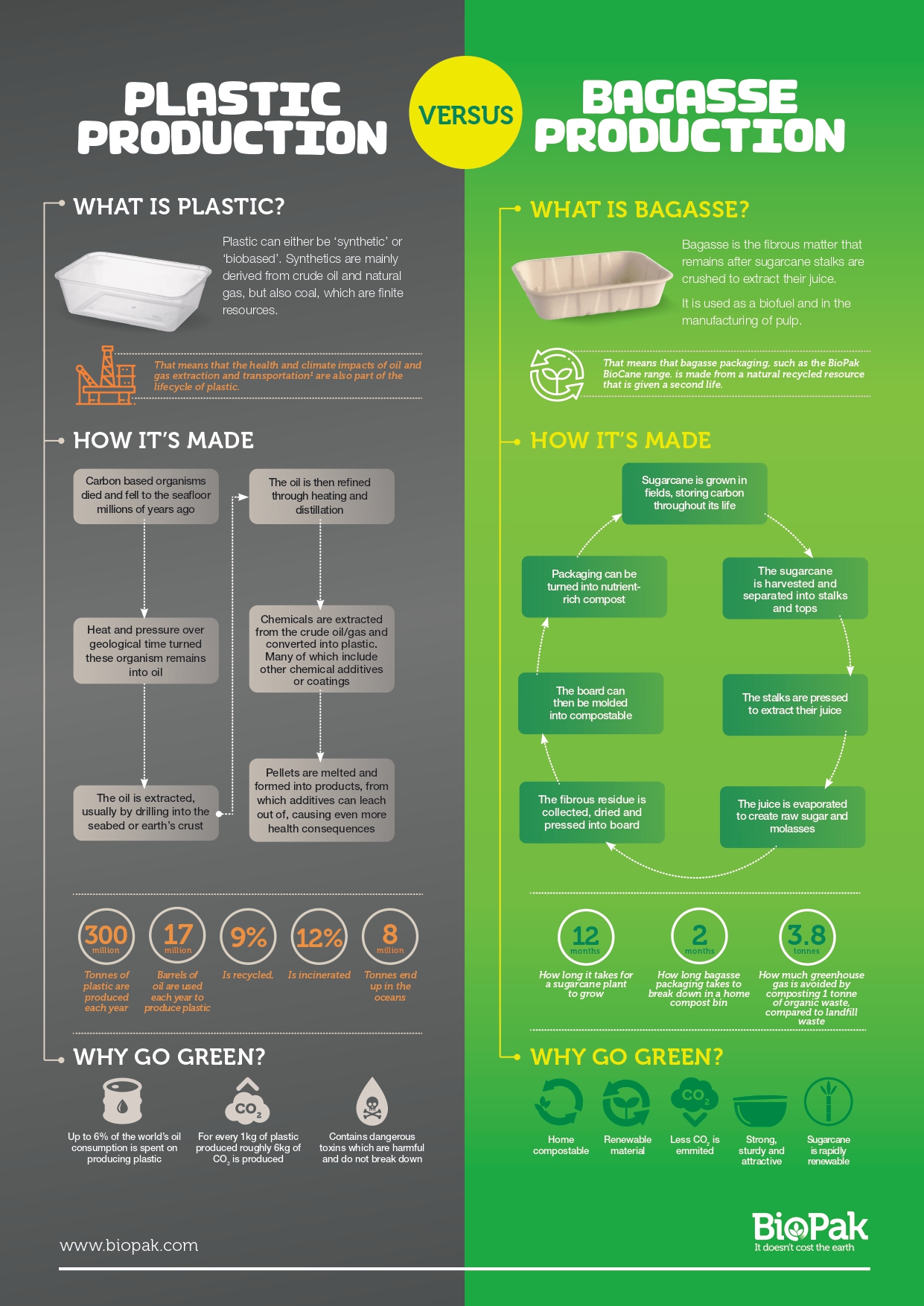
Unlike plastic or polystyrene products, PFAS-free bagasse products are commercially and home compostable. Under composting conditions, bagasse will break down into a nutrient-rich compost that can be used as fertiliser and soil conditioner.
*To understand more about plastic versus baggase, download the pdf to know more